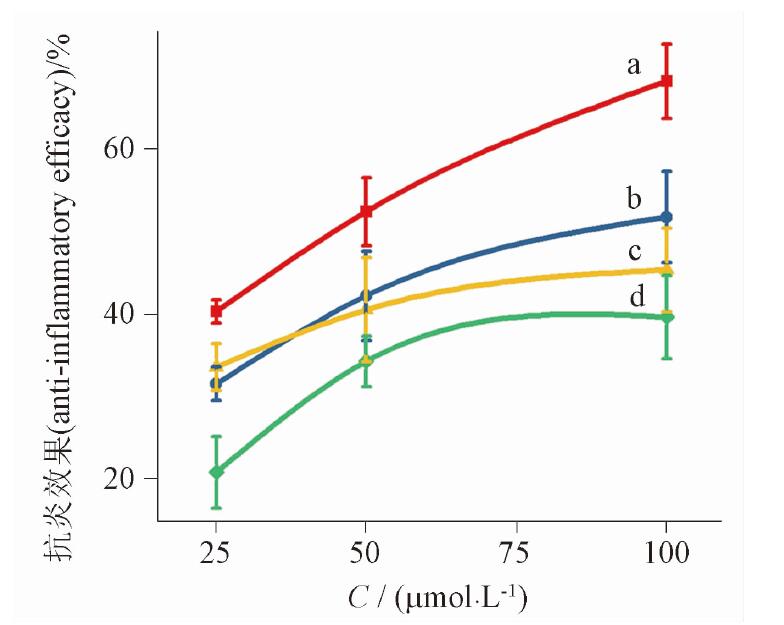
Objective: To establish an integrated model of biosensing technology for the study of zebrafish, and to study and verify the interaction between cetirizine hydrochloride, fexofenadine hydrochloride, mizolastine, and ebastine, with the key target of allergic rhinitis, macrophage migration inhibitory factor(MIF). Methods: A MIF-high electron mobility transistor(HEMT) biosensor was constructed using AlGaAs/GaAs HEMT as the sensing element and MIF as the biological element. The interaction strength between cetirizine hydrochloride, fexofenadine hydrochloride, mizolastine, and ebastine and MIF was characterized. Furthermore, a zebrafish immune inflammation model was established. The number of neutrophil migration in the blank control group, model group, positive drug group, and low, medium, and high-dose drug groups were recorded. And the drug inflammation inhibition rate were calculated. Results: Cetirizine hydrochloride exhibited the strongest binding ability to MIF, with a dissociation constant of 7.05×10⁻¹³ mol·L-1. The KD for the interactions between fexofenadine hydrochloride, mizolastine, and ebastine with MIF were 2.34×10⁻⁸ mol·L-1, 1.94×10⁻⁷ mol·L-1 and 2.44×10⁻⁸ mol·L-1, respectively. All of them had binding effects with MIF. Further the validation using the zebrafish immune anti-inflammatory model revealed that all four antihistamines significantly reduced the number of neutrophil migrations, among which 100 μmol·L-1 of cetirizine hydrochloride achieved a neutrophil migration inhibition rate of 68.5%. Conclusion: This study explores the interaction between antihistamines and the key protein target of AR through the integration of biosensing technology and zebrafish experiments. It was found that MIF is a potential target for antihistamine drugs to exert their pharmacological effects. It provides an important reference for research on drug efficacy and its association with targets.
WANG Jing, WU Zhi-sheng, ZHAO Xiao-jun , ZHAO Jing, HUAN Xing-yue, GUO Xin-yu, WANG Kai-yi, HE Han, YAO Jing-chun, GUAN Yong-xia, LI Shi-rong, ZHANG Gui-min, WANG Yi-fei
. Study on the interaction and validation of antihistamine drugs with MIF based on HEMT biosensing*[J]. Chinese Journal of Pharmaceutical Analysis, 2024
, 44(8)
: 1348
-1355
.
DOI: 10.16155/j.0254-1793.2023-0817
[1] SHAMJI MH, DURHAM SR. Mechanisms of allergen immunotherapy for inhaled allergens and predictive biomarkers[J]. J Allergy Clin Immunol, 2017, 140(6): 1485
[2] BOUSQUET J, ANTO JM, BACHERT C, et al. Allergic rhinitis[J]. Nat Rev Dis Primers, 2020, 6(1): 95
[3] BROZEK JL, BOUSQUET J, AGACHE I, et al. Allergic Rhinitis and its Impact on Asthma (ARIA) guidelines-2016 revision[J]. J Allergy Clin Immunol, 2017, 140(4): 950
[4] THURMOND RL, GELFAND EW, DUNFORD PJ. The role of histamine H1 and H4 receptors in allergic inflammation: the search for new antihistamines[J]. Nat Rev Drug Discov, 2008, 7(1): 41
[5] MA L, ZHENG Y, WANG J, et al. Development of MIF/IL-1beta biosensors for discovery of critical quality attributes and potential allergic rhinitis targets from clinical real-world data by intelligent algorithm coupled with in vitro and in vivo mechanism validation[J]. Biosens Bioelectron, 2021, 194: 113608
[6] MA CF, MA LJ, WANG ZJ, et al. Original end-to-end smart diagnosis framework of systematic critical quality attributes meets FDA standards of phytomedicine by biosensor and multi-information fusion coupled with AI algorithm[J]. Green Chem, 2023, 25(1): 384
[7] O'REILLY C, DOROUDIAN M, MAWHINNEY L, et al. Targeting MIF in cancer: therapeutic strategies, current developments, and future opportunities[J]. Med Res Rev, 2016, 36(3): 440
[8] PAL P, PRATAP Y, GUPTA M, et al. Modeling and simulation of AlGaN/GaN MOS-HEMT for biosensor applications[J]. IEEE Sensors, 2019, 19(2): 587
[9] SANCHEZ-BORGES M, ANSOTEGUI IJ. Second generation antihistamines: an update[J]. Curr Opin Allergy Clin Immunol, 2019, 19(4): 358
[10] 马朝富, 王子健, 马丽娟, 等. 基于MIF-HEMT生物传感技术的同仁牛黄清心丸关键质量属性测量研究[J]. 药学学报, 2023, 58(10): 2853
MA CF, WANG ZJ, MA LJ, et al. The measurement of critical quality attributes of Tongren Niuhuang qingxin pills based on MIF-HEMT biosensor technology[J]. Acta Pharm Sin, 2023, 58(10): 2853
[11] MA LJ, LI BY, MA JC, et al. Novel discovery of schisandrin A regulating the interplay of autophagy and apoptosis in oligoasthenospermia by targeting SCF/c-kit and TRPV1 via biosensors[J]. Acta Pharm Sin B, 2023, 13(6): 2765
[12] CHEN J, WANG H, JIA L, et al. Bufalin targets the SRC-3/MIF pathway in chemoresistant cells to regulate M2 macrophage polarization in colorectal cancer[J]. Cancer Lett, 2021, 513: 63
[13] OSIPYAN A, CHEN D, DEKKER FJ. Epigenetic regulation in macrophage migration inhibitory factor (MIF)-mediated signaling in cancer and inflammation[J]. Drug Discov Today, 2021, 26(7): 1728
[14] CALANDRA T, ROGER T. Macrophage migration inhibitory factor: a regulator of innate immunity[J]. Nat Rev Immunol, 2003, 3(10): 791
[15] SHIMIZU T, NISHIHIRA J, WATANABE H, et al. Cetirizine, an H1-receptor antagonist, suppresses the expression of macrophage migration inhibitory factor: its potential anti-inflammatory action[J]. Clin Exp Allergy, 2004, 34(1): 103