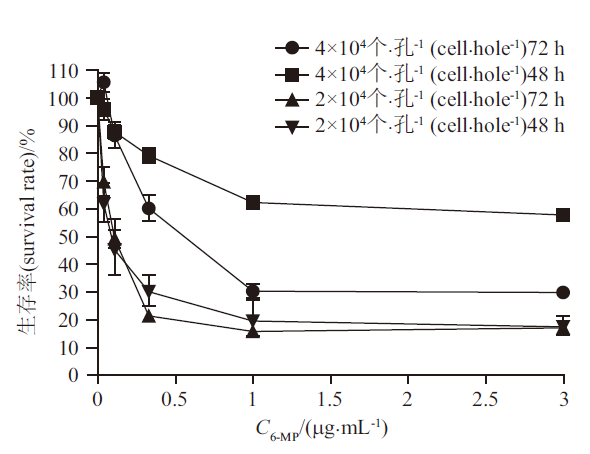
目的: 建立基于人白血病T细胞株Jurkat E6-1的转移因子(TF)生物活性检测方法。方法: 采用细胞毒性和增殖(CCK-8)法探索不同浓度TF对6-巯基嘌呤(6-MP)处理Jurkat E6-1细胞增殖的影响,并对该方法的精密度进行验证。结果: 20 μg·mL-1 TF可使细胞的生存率明显提高,使6-MP的 IC50由(0.46±0.10)μg·mL-1右移至(1.11±0.30)μg·mL-1;当1.0 μg·mL-1 6-MP处理细胞时,TF的浓度和细胞生存率具有良好的线性关系,r>0.95。不同批次间在剂量-反应曲线的每个浓度水平上,RSD均小于20%。TF的半数有效浓度(EC50)为(28.49±9.60)mg·mL-1,可信限率小于20%。结论: TF可以显著提高暴露于6-MP的Jurkat E6-1细胞生存率,该作用呈剂量依赖性,可为TF生物活性测定提供客观、准确的评价手段。
Objective: To develop a method to assess bioactivity of trasfer factor (TF) based on their protective effcets on Jurkat E6-1 cells. Methods: Proliferative effects of different concentrations of TF on 6-mercaptopurine(6-MP) treated Jurkat E6-1 cells detected by CCK-8 assay and the precision was validated. Results: TF exhibited protective activity to change the inhibitory concentration (IC50) value of 6-MP from(0.46±0.10)μg·mL-1 to (1.11±0.30)μg·mL-1 when treated with 20 μg·mL-1 TF. When cells were treated with 6-MP,there is a good linear relationship between the concentration of TF and cell survival rate, r>0.95. At each concentration level of the dose-response curve, the RSD was less than 20%. The median effective concentration (EC50) of TF was (28.49±9.60)μg·mL-1, and the confidence limit was less than 20%. Conclusions: TF significantly improved Jurkat E6-1 cell survival rate in dose dependent manner when challenged with 6-MP. It may be suitable for evaluate bioactivity of TF.
[1] PINEDA B, ESTRADA-PARRA S, PEDRAZA-MEDINA B,et al. Interstitial transfer factor as adjuvant immunotherapy for experimental glioma[J]. J Exp Clin Cancer Res, 2005, 24(4): 575
[2] 古红婷, 邝莹, 陈垒, 等.不同产品转移因子对免疫功能低下小鼠免疫功能的调控及多肽图谱分析[J]. 中南药学, 2023, 21(9): 2282
GU HT, KUANG Y, CHEN L, et al. Regulation of different transfer factors on the immune function in immunocompromised mice and polypeptide profiling[J]. Cent South Pharm, 2023, 21(9): 2282
[3] MACIAS AE, GUANÍ-GUERRA E. Transfer factor: myths and facts[J]. Arch Med Res, 2020, 51(7): 613
[4] OLIVEIRA GCR, DI NF, COUTO RM, et al. Use of transfer factor in immunosuppressed surgical patients [J]. Rev Col Bras Cir, 2017, 44(5): 452
[5] TANG ZL, RUAN JL, CAI SQ. Transfer factor for the treat ment of necrobiotic xanthogranuloma [J]. Dermatol Ther, 2022, 35(12): e15894
[6] VALDIMARSSON H, MCGUIRE RL. Crude transfer-factor preparations stimulate trypsinized human lymphocytes to form rosettes with sheep red cells[J]. Clin Exp Immunol, 1977, 29(2): 261
[7] KIRKPATRICK CH, HAMAD AR, MORTON LC. Murine transfer factors: dose-response relationships and routes of administration[J]. Cell Immunol, 1995, 164(2): 203
[8] PIZZA G, DE VINCI C, FORNAROLA V,et al. In vitro studies during long-term oral administration of specific transfer factor[J]. Biotherapy, 1996, 9(1-3): 175
[9] MEDINA-RIVERO E, MERCHAND-REYES G, PAVÓN L,et al. Batch-to-batch reproducibility of transferon[J]. J Pharm Biomed Anal, 2014,88: 289
[10] FERNÁNDEZ-RAMOS AA, MARCHETTI-LAURENT C, POINDESSOUS V, et al. 6-Mercaptopurine promotes energetic failure in proliferating T cells[J]. Oncotarget, 2017, 8(26): 43048
[11] YANG JY, TAN YQ, ZHOU G. T cell-derived exosomes containing cytokines induced keratinocytes apoptosis in oral lichen planus[J]. Oral Dis, 2022, 28(3): 682
[12] AZAD N, LAPAGLI AL, KIRSTEIN S, et al. Jurkat cell proliferative activity is increased by luteinizing hormone releasing hormone[J]. J Endocrinol, 1997, 153(2): 241
[13] 张刚, 高晓慧, 吴海兵,等.地西他滨诱导人急性淋巴细胞白血病Jurkat E6-1细胞凋亡机制的研究[J]. 中国现代医生. 2020,58(1):26
ZHANG G, GAO XH, WU HB, et al. Study on the mech anism of apoptosis induced by decitabine in human acute lymphoblastic leukemia Jurkat cells [J]. China Mod Docto, 2020, 58(1): 26
[14] 中华人民共和国药典 2020 年版. 四部[S]. 2020: 216
ChP 2020. Vol Ⅳ [S]. 2020: 216
[15] CARDOSO FM, TOMKOVA M, PETROVAJOVA D, et al. New and cost effective cell-based assay for dialyzed leukocyte extract (DLE)-induced Jurkat cells proliferation under azathioprine treatment [J]. J Pharm Biomed Anal, 2017, 138: 100
[16] VESELY MD, KERSHAW MH, SCHREIBER RD, et al. Natural innate and adaptive immunity to cancer [J]. Annu Rev Immunol, 2011, 29: 235
[17] VIVIER E, RAULET DH, MORETTA A, et al. Innate or adaptive immunity? The example of natural killer cells[J]. Science, 2011, 331(6013): 44
[18] KADOWAKI N, ANTONENKO S, LAU JY, et al. Natural interferon alpha/beta-producing cells link innate and adaptive immunity[J]. J Exp Med, 2000, 192(2): 219
[19] PAVLICEVIC M, MARMIROLI N, MAESTRI E. Immunomodulatory peptides-A promising source for novel functional food production and drug discovery[J]. Peptides, 2022, 148: 170696
[20] CARBALLO-UICAB G, LINARES-TREJO JE, MELLADO-SáNCHEZ G, et al. Validation of a cell proliferation assay to assess the potency of a dialyzable leukocyte extract intended for batch release[J]. Molecules, 2019, 24(19): 3426
[21] ABRAHAM RT, WEISS A. Jurkat T cells and development of the T-cell receptor signalling paradigm[J]. Nat Rev Immunol, 2004, 4(4): 301
[22] BECERRA E, BERUMEN L, SOTO-ONTIVEROS V, et al. Specific MRP4 inhibitor ceefourin-1 enhances apoptosis induced by 6-mercaptopurine in Jurkat leukemic cells, but not in normal lymphoblast cell line CRL-1991[J]. Medicina (Kaunas), 2022, 58(6): 695
[23] HAGLUND S, VIKINGSSON S, ALMER S, et al. Combination treatment with 6-mercaptopurine and allopurinol in HepG2 and HEK293 cells-effects on gene expression levels and thiopurine metabolism[J]. PLoS One, 2017, 12(3): e0173825
[24] YOO YG, NA TY, YANG WK, et al. 6-Mercaptopurine, an activator of Nur77, enhances transcriptional activity of HIF-1alpha resulting in new vessel formation[J]. Oncogene,2007, 26(26):3823